After more than 05 years of implementation, alongside its positive outcomes, the Law on Investment 2020 has revealed several limitations concerning the provisions on investors’ freedom of business, investment incentive and support policies, as well as procedures for carrying out investment and business activities in Vietnam.

With a view to addressing these shortcomings, the Ministry of Planning and Investment has completed the first draft of the Law on Business Investment (“Draft”). The Draft introduces major reform proposals, succeeding and replacing the Law on Investment 2020, with the objective of removing barriers to investment activities, promoting private sector investment, and enhancing national competitiveness. The key highlights of the Draft are as follows:

A significant proposed change under the Draft is the addition of cases exempted from investment policy approval. Specifically, the Draft provides that the following projects shall not be subject to investment policy approval procedures: projects already specified in sectoral or provincial master plans with defined names, scales, objectives, locations, and timelines; projects awarded through land use right auctions or bidding for land-use projects; and mineral exploitation or industrial cluster infrastructure development projects. This change aims to simplify procedures and resolve existing bottlenecks in the current implementation process.

Regarding foreign investment activities, under the current Law on Investment 2020, a foreign investor must have an approved investment project before establishing an economic organization in Vietnam. However, the Draft proposes to abolish this principle, allowing foreign investors to apply for an Enterprise Registration Certificate (ERC) before applying for an Investment Registration Certificate (IRC). This approach increases flexibility for investors but also necessitates stronger control over market access conditions at the enterprise establishment stage, as well as clear guidance on the timeline that the investor must obtain IRC after the issuance of ERC.

Another groundbreaking reform proposed in the Draft is the removal of 17 conditional business lines, including accounting services, rice export, labor subleasing, funeral services, overseas study consultancy, and performing arts, repairing, maintaining of cars, among others.

The Draft also proposes to abolish the list of conditional outward investment sectors and clarify the authority for issuing outward investment registration certificates. Specifically, outward investment projects with capital of VND 20 billion or more shall fall under the licensing authority of the Ministry of Planning and Investment. Projects with capital below VND 20 billion shall not be subject to the outward investment registration certificate requirement; instead, investors will only need to register foreign exchange transactions in accordance with the laws on foreign exchange management.

In addition, a notable revision concerns the adjustment of the scope and criteria for determining investment incentive locations. The Draft categorizes incentive areas into two groups: areas with difficult or particularly difficult socio-economic conditions; and  industrial zones, export processing zones, high-tech zones, concentrated digital technology zones, and economic zones. Accordingly, industrial zones, export processing zones, high-tech zones, concentrated digital technology zones, and economic zones are now established as an independent group of incentive areas, rather than being classified within areas of difficult or particularly difficult socio-economic conditions as before. This approach enables a more tailored design of incentive policies aligned with the characteristics of each type of investment area.

Overall, the Draft represents an important institutional breakthrough, aiming to establish a more open, transparent, and competitive investment environment for both domestic and foreign investors. The proposed reforms — including the abolition and simplification of investment policy approval procedures, enhanced autonomy for foreign investors in enterprise establishment, and the substantial reduction of conditional business sectors — reaffirm the Government’s commitment to fostering private investment and improving Vietnam’s overall investment climate.

On October 9, 2025, the Ministry of Public Security has published the draft Resolution of the Government regarding the removal of notarization and marital status certification procedures (“Draft”). Aiming to meet the objectives of administrative procedure reform and national digital transformation, the Draft Resolution proposes to abolish the requirements for notarization and marital status certification in land and vehicle transactions for cases where data has already been digitized and verified.

The Draft seeks to simplify administrative procedures by completely eliminating paper-based documents for two types of transactions: transactions involving the sale, transfer, donation, mortgage, or inheritance of land use rights and assets attached to land; and) transactions involving the sale, transfer, donation, or registration of ownership of vehicles.

Accordingly, instead of requiring notarization and paper-based certification, these procedures would be integrated and automated based on existing data available in the national databases on population, civil status, land, and vehicles.

The Draft also emphasizes and affirms the legal validity of digitized and electronically authenticated data. Data collected and verified from these national databases will have the same legal effect as paper documents, and citizens will not be required to resubmit documents that already exist in the national data systems. Officials and civil servants will be responsible for retrieving and verifying information directly from the electronic system, rather than requesting paper copies from citizens.

With respect to implementation procedures, the Draft Resolution proposes to abolish the requirement for notarization and marital status certification in relevant administrative processes to eliminate unnecessary formalities, thereby reducing costs, shortening processing time, and minimizing overlapping documentation.

For cases where data has been digitized and authenticated, citizens will only need to log into the National Public Service Portal or the VNeID application to declare transaction information. The electronic data system will automatically verify personal information, marital status, land use rights, and vehicle ownership. Contracts will be created, signed, and stored on the electronic platform, with transaction results returned either online or in person, depending on the citizen’s choice.

In cases where such data has not yet been digitized within the national databases, the competent authority may request paper documents once only, while also guiding citizens on updating their information to enable simplified procedures for future transactions.

Overall, the Draft Resolution is considered a breakthrough in institutional reform, establishing a legal framework for the use of electronic data in civil transactions. It is expected to significantly reduce administrative procedures, costs, and processing time for both citizens and businesses, while enhancing public satisfaction and trust in the Government amid the ongoing process of digital transformation and international integration.

1. Draft Law on Investment: Breakthrough to promote private investment and enhance national competitiveness
After more than 05 years of implementation, alongside its positive outcomes, the Law on Investment 2020 has revealed several limitations concerning the provisions on investors’ freedom of business, investment incentive and support policies, as well as procedures for carrying out investment and business activities in Vietnam.
With a view to addressing these shortcomings, the Ministry of Planning and Investment has completed the first draft of the Law on Business Investment (“Draft”). The Draft introduces major reform proposals, succeeding and replacing the Law on Investment 2020, with the objective of removing barriers to investment activities, promoting private sector investment, and enhancing national competitiveness. The key highlights of the Draft are as follows:

A significant proposed change under the Draft is the addition of cases exempted from investment policy approval. Specifically, the Draft provides that the following projects shall not be subject to investment policy approval procedures: projects already specified in sectoral or provincial master plans with defined names, scales, objectives, locations, and timelines; projects awarded through land use right auctions or bidding for land-use projects; and mineral exploitation or industrial cluster infrastructure development projects. This change aims to simplify procedures and resolve existing bottlenecks in the current implementation process.
Regarding foreign investment activities, under the current Law on Investment 2020, a foreign investor must have an approved investment project before establishing an economic organization in Vietnam. However, the Draft proposes to abolish this principle, allowing foreign investors to apply for an Enterprise Registration Certificate (ERC) before applying for an Investment Registration Certificate (IRC). This approach increases flexibility for investors but also necessitates stronger control over market access conditions at the enterprise establishment stage, as well as clear guidance on the timeline that the investor must obtain IRC after the issuance of ERC.

Another groundbreaking reform proposed in the Draft is the removal of 17 conditional business lines, including accounting services, rice export, labor subleasing, funeral services, overseas study consultancy, and performing arts, repairing, maintaining of cars, among others.

The Draft also proposes to abolish the list of conditional outward investment sectors and clarify the authority for issuing outward investment registration certificates. Specifically, outward investment projects with capital of VND 20 billion or more shall fall under the licensing authority of the Ministry of Planning and Investment. Projects with capital below VND 20 billion shall not be subject to the outward investment registration certificate requirement; instead, investors will only need to register foreign exchange transactions in accordance with the laws on foreign exchange management.

In addition, a notable revision concerns the adjustment of the scope and criteria for determining investment incentive locations. The Draft categorizes incentive areas into two groups: areas with difficult or particularly difficult socio-economic conditions; and industrial zones, export processing zones, high-tech zones, concentrated digital technology zones, and economic zones. Accordingly, industrial zones, export processing zones, high-tech zones, concentrated digital technology zones, and economic zones are now established as an independent group of incentive areas, rather than being classified within areas of difficult or particularly difficult socio-economic conditions as before. This approach enables a more tailored design of incentive policies aligned with the characteristics of each type of investment area.

Overall, the Draft represents an important institutional breakthrough, aiming to establish a more open, transparent, and competitive investment environment for both domestic and foreign investors. The proposed reforms — including the abolition and simplification of investment policy approval procedures, enhanced autonomy for foreign investors in enterprise establishment, and the substantial reduction of conditional business sectors — reaffirm the Government’s commitment to fostering private investment and improving Vietnam’s overall investment climate.

2. Breakthrough proposal in eliminating notarization and marital status certification in land and vehicle transactions

On October 9, 2025, the Ministry of Public Security has published the draft Resolution of the Government regarding the removal of notarization and marital status certification procedures (“Draft”). Aiming to meet the objectives of administrative procedure reform and national digital transformation, the Draft Resolution proposes to abolish the requirements for notarization and marital status certification in land and vehicle transactions for cases where data has already been digitized and verified.

The Draft seeks to simplify administrative procedures by completely eliminating paper-based documents for two types of transactions: transactions involving the sale, transfer, donation, mortgage, or inheritance of land use rights and assets attached to land; and) transactions involving the sale, transfer, donation, or registration of ownership of vehicles.

Accordingly, instead of requiring notarization and paper-based certification, these procedures would be integrated and automated based on existing data available in the national databases on population, civil status, land, and vehicles.

The Draft also emphasizes and affirms the legal validity of digitized and electronically authenticated data. Data collected and verified from these national databases will have the same legal effect as paper documents, and citizens will not be required to resubmit documents that already exist in the national data systems. Officials and civil servants will be responsible for retrieving and verifying information directly from the electronic system, rather than requesting paper copies from citizens.

With respect to implementation procedures, the Draft Resolution proposes to abolish the requirement for notarization and marital status certification in relevant administrative processes to eliminate unnecessary formalities, thereby reducing costs, shortening processing time, and minimizing overlapping documentation.
For cases where data has been digitized and authenticated, citizens will only need to log into the National Public Service Portal or the VNeID application to declare transaction information. The electronic data system will automatically verify personal information, marital status, land use rights, and vehicle ownership. Contracts will be created, signed, and stored on the electronic platform, with transaction results returned either online or in person, depending on the citizen’s choice.

In cases where such data has not yet been digitized within the national databases, the competent authority may request paper documents once only, while also guiding citizens on updating their information to enable simplified procedures for future transactions.

Overall, the Draft Resolution is considered a breakthrough in institutional reform, establishing a legal framework for the use of electronic data in civil transactions. It is expected to significantly reduce administrative procedures, costs, and processing time for both citizens and businesses, while enhancing public satisfaction and trust in the Government amid the ongoing process of digital transformation and international integration.

3. Tightening measures against delayed or evasive social insurance contributions
On 30 November 2025, Decree No. 274/2025/NĐ-CP, detailing the implementation of several provisions of the Law on Social Insurance regarding delayed and evasive contributions to compulsory social insurance and unemployment insurance, as well as complaints and denunciations in the field of social insurance (“Decree 274”), will officially take effect.

Under Decree 274, enterprises that delay or evade the payment of compulsory social insurance and unemployment insurance contributions shall be required to pay an additional interest of 0.03% per day, calculated based on the amount and number of days of delayed or unpaid contributions. This is a strong measure aimed at enhancing deterrence, safeguarding employees’ entitlements, and ensuring strict compliance with insurance obligations.

Notably, Decree 274 also provides that acts of delayed payment may be reclassified as acts of evasion if the enterprise fails to remedy the delay within 60 days from the statutory payment deadline or fails to fulfil its obligations after receiving a written reminder from the social insurance authority.

However, in the spirit of supporting and accompanying enterprises, Decree 274 also recognizes certain circumstances that shall not be considered as acts of evasion, including: severe natural disasters such as storms, floods, or droughts; dangerous epidemics officially declared by competent authorities; impacts caused by a state of emergency as prescribed by law; and other force majeure events as defined under the Civil Code.

With the promulgation of Decree 274, the Government reaffirms its determination to tighten discipline in the implementation of social insurance obligations, while simultaneously promoting transparency and accountability among enterprises in ensuring the lawful rights and benefits of employees.

4. Guidance on monthly invoice issuance

On October 10, 2025, the Da Nang City Tax Department issued Official Letter No. 1820/DAN-QLDN2 (“Official Letter”) to address enterprises’ inquiries regarding the timing of invoice issuance and the delivery of goods and services at the end of the month in accordance with regulations on invoices and supporting documents.

The Official Letter reaffirms the general principle that the time of invoice issuance is the time when ownership or the right to use goods is transferred to the buyer, or when the provision of services is completed.

Only in cases involving the sale of goods or the provision of services in large quantities and on a frequent basis—such as electricity, water supply, television, telecommunications, securities, computerized lottery, and transportation support services for railway, road, and aviation—may the seller issue monthly invoices based on an agreed-upon billing cycle between the parties.

Accordingly, the Official Letter emphasizes that for transactions not falling under the aforementioned categories, enterprises are not permitted to issue invoices on a monthly basis, even if the parties have a written agreement stipulating the issuance of monthly invoices.

5. Ho Chi Minh City implements electronic business registration certificates

On October 24, 2025, the Ho Chi Minh City Department of Finance issued Notice No. 10441/TB-STC on the implementation of digital signing for the results of administrative procedures in the field of enterprise registration.

According to the notice, from October 25, 2025, the results of administrative procedures such as applications for new business registration certificates or amended business registration certificates will be issued in electronic form instead of paper form as previously. The business registration authority will no longer issue paper versions, and the electronic certificates will hold the same legal validity as paper documents.

The implementation of electronic business registration certificates in Ho Chi Minh City marks the next step in the city’s digital transformation of business registration procedures, helping to simplify processes, reduce costs, and save time for enterprises.

Previously, the Hanoi Business Registration Office had already adopted the issuance of electronic certificates, and this policy is expected to be rolled out nationwide in the near future in line with the overall trend toward digitalization.

The introduction of electronic business registration certificates demonstrates the government’s strong commitment to administrative reform and digital transformation, while also facilitating a more convenient and efficient process for enterprises in fulfilling their business registration requirements.
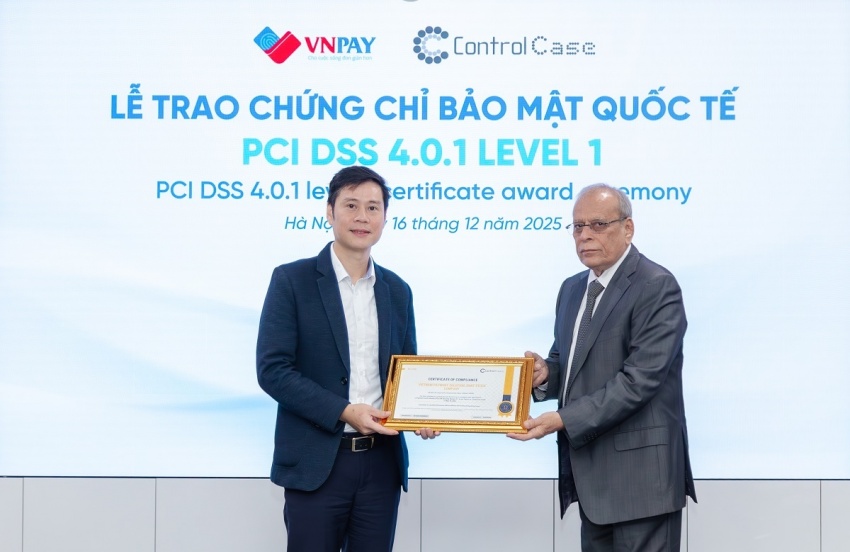
On December 16, VNPAY was granted the PCI DSS 4.0.1 certification by international assessment organisation Control Case for six services, including Cloud, Payment Gateway, SmartPOS, VNTAP-HCE, Tap to Phone, and PhonePOS. The services met all 12 core security requirements under the global Payment Card Industry Data Security Standard, as issued by the PCI Security Standards Council.

VNPAY has earned the highest-level PCI DSS certification since 2020, for six straight years, keeping pace with ongoing updates to the standard. To maintain this certification, VNPAY’s services must comply with 12 principles, meet more than 250 stringent requirements on information security and data management, and fully satisfy six security goals in line with PCI DSS standards: Build and maintain a secure network; Protect cardholder data; Maintain a vulnerability management programme; Implement strong access control measures; Regularly monitor and test networks; and maintain an information security policy.

Tran Manh Cuong, deputy CEO of VNPAY, said, “The attainment of the highest-level PCI DSS 4.0.1 certification demonstrates VNPAY’s long-term commitment to building and maintaining security systems in line with international standards. VNPAY will continue to improve and enhance its security standards with a view to maximising customer data protection and contributing to a safe and sustainable digital payment ecosystem.”

VNPAY services achieve the highest-level PCI DSS international security certificates for six consecutive years
Tran Manh Cuong (left), deputy CEO of VNPAY, receives the PCI DSS 4.0.1 Level 1 certificate

The PCI DSS certificate is a mandatory information security standard for all businesses that store, process, or transmit payment card data. The standard is managed by five international payment organisations, namely Visa, MasterCard, American Express, Discover, and JCB.

PCI DSS 4.0.1 is a security standard encompassing a rigorous and stringent set of requirements to ensure the protection of cardholder data throughout the storage, processing, and transmission through technical, procedural, and human control measures.

VNPAY services achieve the highest-level PCI DSS international security certificates for six consecutive years
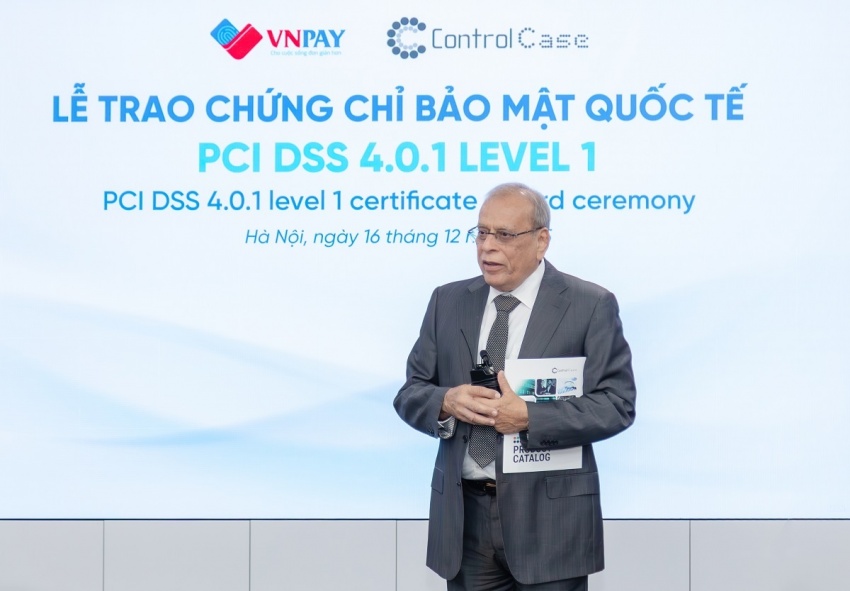
Suresh Kumar Dadlani, chairman and director of Control Case, awarded the PCI DSS 4.0.1 Level 1 international security certificate to VNPAY

VNPAY Cloud provides cloud computing and AI services for large enterprises, financial partners, banks, and fintechs. In line with the future development trend of cloud models, the company is focusing on developing its cloud services as software-as-a-service products, allowing businesses to easily reach their customers, expand the digital ecosystem, and meet rapidly growing needs.

VNPAY SmartPOS is a comprehensive payment solution enabling businesses to deploy various payment methods easily. The devices have built-in features including card payment, VNPAY-QR code payment, invoice printing, and barcode scanning, thereby making payment flexible and fast.

SmartPOS integrates features includingcard payment, VNPAY-QR code payment, invoice printing, and barcode scanning.

VNPAY services receive the highest-level PCI DSS international security certificates for six consecutive years
SmartPOS integrates features such as card payment, VNPAY-QR payment, receipt printing, and barcode scanning.

VCB Tap to Phone is a tap to pay solution on smartphones, transforming any NFC-enabled Android smartphones into Visa’s contactless POS devices or enabling payments on other smartphones integrated with cards with just a few steps. With VCB Tap to Phone, businesses can process transactions by tapping into smartphones rather than using traditional POS devices. The service offers convenience and flexibility in payment while reducing investment costs for businesses.

VNPAY PhonePOS turns a phone into a point of sale. With an Android phone with NFC support, any point of sale can accept international cards quickly, conveniently, and safely. This marks a strategic step in VNPAY’s journey to complete its cashless payment ecosystem and underscores its commitment to supporting partners in effective digital transformation at the point of sale.

VNTAP (Tap2Pay) is an advanced card payment technology integrated into the VNPAY app. Card information is tokenised on the application, turning Android phones into cards with touch payment technology. It enables customers to make payments anytime, anywhere at NFC-enabled POS terminals without a physical card. VNTAP delivers a simple, seamless, and secure experience in line with digital technology trends.

VNPAY services achieve the highest-level PCI DSS international security certificates for six consecutive years
Receiving the highest PCI DSS certification for six consecutive years is a significant milestone in VNPAY’s journey to improve security standards

The VNPAY Payment Gateway is an intermediary gateway connecting businesses with banks. Customers can use bank cards/accounts, QR Pay/VNPAY-QR features built into 40 mobile banking applications, the VNPAY app, and over 15 e-wallets to pay for transactions. There are over 450,000 VNPAY-QR payment acceptance points using TLS 1.2 encryption with strong encryption algorithms.

VNPAY PhonePOS empowers small merchants to accept international card payments and serve foreign customers VNPAY PhonePOS empowers small merchants to accept international card payments and serve foreign customers

VNPAY PhonePOS empowers small businesses to accept international cards using just a smartphone.

VNPAY clinches two titles at the 2025 ABF FinTech Awards VNPAY clinches two titles at the 2025 ABF FinTech Awards

VNPAY was honoured with two gongs at the 2025 Asia Banking & Finance (ABF) FinTech Awards, underscoring the company’s efforts to drive technological innovation and refine its comprehensive digital ecosystem strategy.

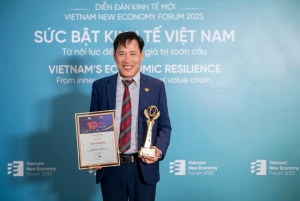
VNPAY chairman named among Top 10 Outstanding Entrepreneurs VNPAY chairman named among Top 10 Outstanding Entrepreneurs

Tran Tri Manh, chairman of the Board of Directors of VNPAY, was honoured as one of the Top 10 Outstanding Vietnamese Entrepreneurs at Vietnam New Economy Forum in Hanoi on October 2.

The apparel sector is in a final sprint to complete its 2025 targets, with total export value estimated at $46 billion, against the backdrop of sharp fluctuations in the global market.

Although this figure falls short of the original $48 billion target, it still represents a 5.6 per cent increase on-year, helping Vietnam retain its position among the world’s top three garments and textiles exporters.

“A shortfall of $2 billion was unavoidable in 2025 due to a series of disruptions stemming from global market shifts and international policy changes,” said Vu Duc Giang, chairman of the Vietnam Textile and Apparel Association (VITAS), at a press conference in Hanoi on December 10.

Garment and textile sector seeks new growth after volatile year

Escalating US-China trade tensions have pushed up tariffs on many textile-based products, while a complex geopolitical environment has directly affected global orders and purchasing power. On the demand side, consumers have continued to tighten spending, forcing manufacturers to accept smaller orders with faster delivery requirements and compressed production timelines.

This has significantly eroded profit margins. Businesses have had to constantly juggle fragmented orders, adjust production plans and increase investment to meet green standards and traceability requirements to retain international clients.

The business picture at Thanh Cong Textile Garment Investment Trading JSC (TCM) clearly reflects the sector’s growing divergence. Over the first 10 months of the year, TCM recorded profits approximating $9.5 million, down 2 per cent on-year, while revenue came to around $120.1 million, a decline of 5 per cent.

Its operating cash flow for the first nine months contracted approximately $3.8 million, compared with a positive $12.2 million in the same period last year. Even so, the company has secured additional orders through the first quarter of 2026, supported by seasonal holiday demand and a competitive edge as the US imposes higher tariffs on imports from several other exporting countries.

“As profit margins narrow and cash flows weaken, the industry is being forced to reassess internal capabilities, from production organisation to the level of autonomy within supply chains,” said Cao Huu Hieu, general director of the Vietnam National Textile and Garment Group, noting that the sector’s most enduring challenge remains dependence on imported raw materials.

The yarn segment totally relies on imported cotton, along with 90-95 per cent of fibres and a wide range of chemicals and dyes, posing a major risk should the US tighten tariffs on products with a high proportion of third-country origin.

According to VITAS, the Middle East and Africa are emerging as new growth destinations for Vietnamese garments and textiles exports, as traditional markets become increasingly volatile.

In the Middle East alone, the sector’s exports generated around $1 billion in 2024 and reached $700 million in just the first seven months of 2025. These results highlight the industry’s adaptability, as Vietnamese firms not only defended their mass-market segments but also gradually moved into higher value-added product lines with greater technological and design content.

Alongside export market expansion, many local garment manufacturers, including foreign-backed firms, are accelerating overseas investments.

Currently, nearly 30 companies in the sector have established a presence in Indonesia, Myanmar, and parts of Africa, South Asia, and Latin America. Pioneers such as May Song Hong and Phong Phu International Textile Group are gradually building multinational production networks, enhancing competitiveness and gaining greater resilience against global shocks.

“The multi-site production model allows companies to spread political and trade risks, optimise labour and transportation costs, and strengthen their reputation and ability to retain international customers,” said Vu Duc Giang, chairman of VITAS.

In practice, labour costs at factories in countries such as Indonesia and Egypt are significantly lower than in Vietnam, offering a clear advantage in product pricing.

Beyond labour considerations, many host countries enjoy favourable trade relations with major markets, with low or even zero tariffs, allowing firms to benefit from preferential treatment at the export stage. In addition, logistics costs and access to raw materials in some markets are better aligned with long-term production scale expansion strategies.

“We are gradually reducing our reliance on the US market, which is particularly vulnerable to policy shifts and tariff changes,” said Tran Nhu Tung, chairman of the Board at TCM.

Instead, TCM is intensifying its focus on the EU and markets covered by the Comprehensive and Progressive Agreement for Trans-Pacific Partnership and the Regional Comprehensive Economic Partnership to capitalise on tariff incentives and access orders with higher technical requirements.

This strategy is expected to help TCM protect profit margins, improve cash flow in the short term, and create additional growth momentum from late 2025 into the first half of 2026.

Textile apparel firms see mixed performance Textile apparel firms see mixed performance

Amid a rebound in momentum, businesses in the textile and apparel sector have delivered a mixed business picture so far this year.

Apparel sector players being proactive to surmount hard times Apparel sector players being proactive to surmount hard times

Despite being bottomed-out, textile and garment firms remain prudent in business performance for the rest of this year to weather stormy times.

Garment giants post robust Q1 profits despite global trade headwinds Garment giants post robust Q1 profits despite global trade headwinds

Vietnamese textile apparel producers saw impressive profit growth in the first quarter (Q1) of 2025, signaling a strong recovery in the sector.

The prize affirms PVT Logistics’ tireless efforts to modernise its management system, optimise operational efficiency, and expand its shipping and logistics network across regional and international markets.

PVT Logistics honoured with ‘Fast Enterprise Award’ at APEA 2025

As one of the region’s most prestigious business recognitions, APEA honours leading enterprises across the Asia-Pacific that demonstrate visionary leadership, innovation, and sustainable growth.

Fong Chan Onn, chairman of APEA, remarked, “Enterprises that thrive in today’s dynamic economy are those that embrace innovation, prioritise sustainable development, and place people at the heart of their strategy. PVT Logistics is a remarkable example of this forward-thinking spirit.”

Receiving the Fast Enterprise Award marks a significant milestone for PVT Logistics, reaffirming its position as a trusted and dynamic force in the regional maritime transport and logistics industry, while inspiring the company to reach new heights in its growth journey.

The Asia Pacific Enterprise Awards (APEA) is a prestigious regional platform recognising entrepreneurial excellence. Organised by Enterprise Asia, APEA aims to unite leading business leaders and organisations that demonstrate sustainable growth, innovation, and responsible leadership across Asia-Pacific.

PVT Logistics sets $3.3 million profit target, eyes move to HSX PVT Logistics sets $3.3 million profit target, eyes move to HSX

PVT Logistics is set to transition from the Unlisted Public Company Market (UPCoM) to the Ho Chi Minh Stock Exchange (HSX) by the end of 2024, aiming to enhance its market visibility and attract further investments, while also planning a capital increase of $9.58 million to fund fleet expansion and improve operational performance.

Shipping firms hesitant to devise 2025 plans amid uncertainties Shipping firms hesitant to devise 2025 plans amid uncertainties

An expected cool-down of marine freight rates alongside other uncertainties have made shipping firms cautious about their business strategies for the year ahead.

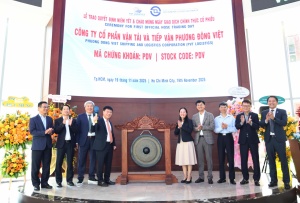
PVT Logistics debuts on HSX PVT Logistics debuts on HSX

PVT Logistics listed over 66 million shares on the Ho Chi Minh City Stock Exchange (HSX) on November 19 under the stock code PDV, paving the way for the company to attract new capital.

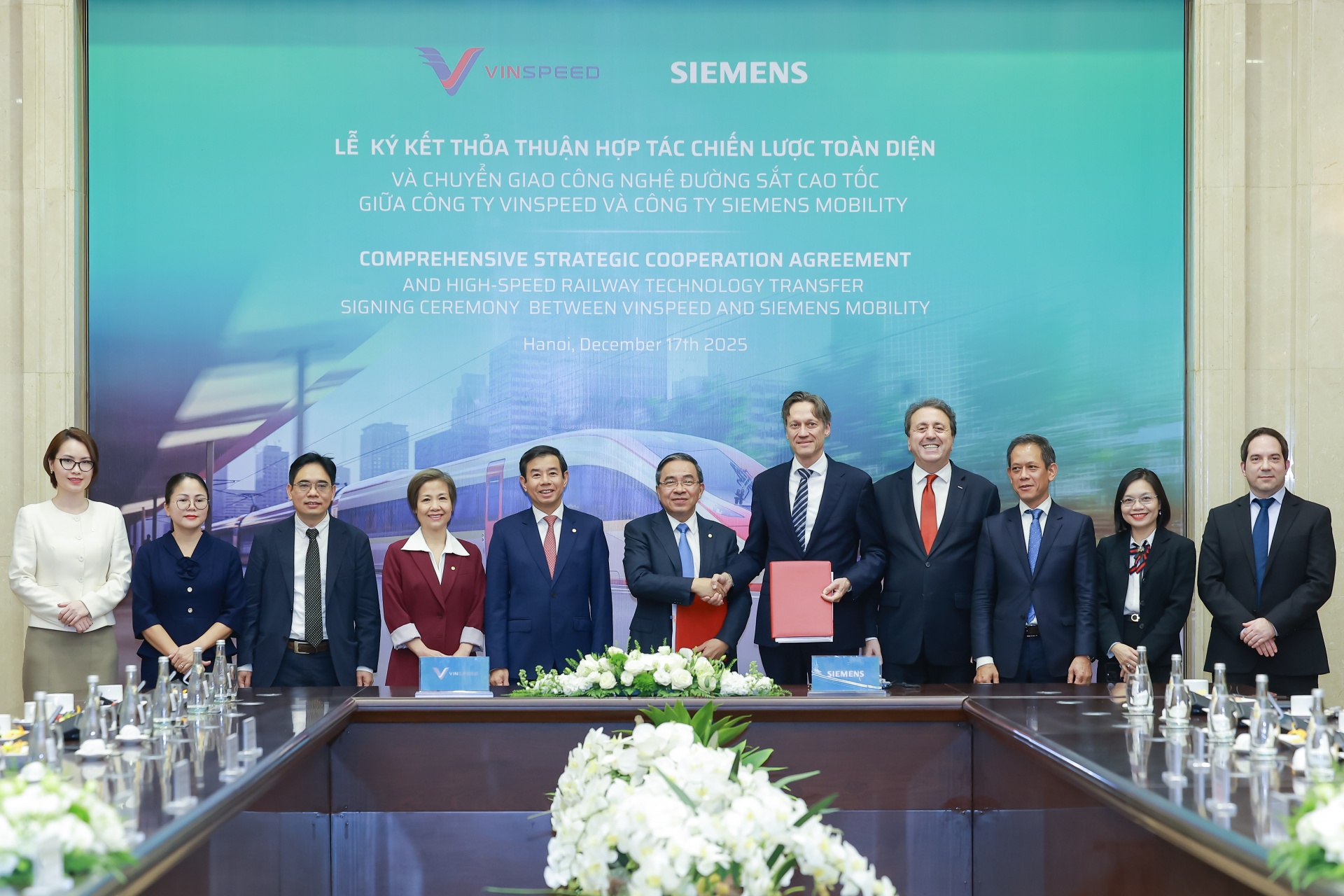
Siemens Mobility will serve as a technology partner, responsible for the design, supply, and integration of modern Velaro Novo trains and key railway subsystems, including ETCS level 2 signalling with automatic train operation (ATO), telecommunications, and electrification systems.

VinSpeed ​​and Siemens strengthen cooperation for high-speed rail development in Vietnam

Siemens Mobility is also exploring opportunities to deliver advanced maintenance services.

Both parties are committed to close collaboration, laying the foundation for the development of a modern, international-standard rail infrastructure in Vietnam.

Giving remarks at the agreement signing ceremony, Michael Peter, CEO of Siemens Mobility, said, “We are proud that the global frontrunner VinSpeed ​​has selected Siemens Mobility to deliver Vietnam’s first high-speed rail lines. This confidence in our turnkey expertise and technology underscores Siemens’ position as the partner of choice for ambitious mobility projects worldwide.”

“Velaro Novo, our most advanced high-speed train platform, delivers up to 30 per cent lower energy consumption, 10 per cent higher passenger capacity, and proven reliability, tailored for Vietnam’s challenging terrain. Together, we are setting new standards for rail travel, driving innovation, and helping position Vietnam as a leader in high-speed mobility,” he noted.

Pham Thieu Hoa, CEO of VinSpeed, said the strategic cooperation with Siemens Mobility marks an important step in VinSpeed’s roadmap for developing modern transport infrastructure in Vietnam.

“The combination of VinSpeed’s execution capabilities and deep understanding of the domestic market with Siemens Mobility’s global experience and advanced technology will create a strong foundation for delivering international-standard high-speed rail lines, contributing to propelling economic development and improving quality of life for the Vietnamese people,” he added.

VinSpeed ​​and Siemens strengthen cooperation for high-speed rail development in Vietnam
The Velaro Novo high-speed train will get exposure across Vietnam

Two high-speed routes have already been proposed: the Hanoi-Quang Ninh (Halong) line, covering 121 km with four stations; and the Ben Thanh-Can Gio line, spanning 54 km with two stations. All lines will be equipped with state-of-the-art rail technologies.

Active in Vietnam since 1993, Siemens has played a pivotal role in supporting Vietnam’s industrialisation, providing advanced technologies and solutions across sectors such as energy, healthcare, and transportation.

In the rail sector, Siemens is a partner to deliver modern passenger and freight transportation, enabling operators to shape today’s and tomorrow’s mobility.

With a strong local presence, including offices in Hanoi, Danang, and Ho Chi Minh City, Siemens offers digital solutions and software, rail infrastructure, rail services, rolling stock and components, and turnkey rail solutions, continuing to contribute to Vietnam’s growth, innovation, and integration into the global economy.

Siemens leads technology transformation towards sustainability in Vietnam Siemens leads technology transformation towards sustainability in Vietnam

Siemens is harnessing advanced digital technologies and AI to drive global sustainability, enhancing efficiency, reducing emissions, and supporting Vietnam’s transition towards a smarter, cleaner future.

Siemens and AIT unveil digital switchboard tailored for high-end clients Siemens and AIT unveil digital switchboard tailored for high-end clients

Siemens Vietnam and AIT Corporation have launched the SIVACON S8, a next-generation digital main switchboard, in Ho Chi Minh City.

Harnessing technology for a sustainable future in Vietnam Harnessing technology for a sustainable future in Vietnam

Siemens is driving Vietnam’s green growth through digital innovation. From advanced automation to digital twin technology, the company industries helps boost efficiency, cut emissions, and build resilience. Thai-Lai Pham, president & CEO of Siemens ASEAN & Vietnam, shared with VIR’s Olivia Bui how company global sustainability strategies are shaping Vietnam’s transformation.

In addition, a higher proportion of respondents say that onsite renewable energy production and the electrification of heating and cooling are now at mature or advanced stages, compared with previous findings in 2023.

Energy efficiency in buildings tops organisations’ infrastructure priorities
Energy efficiency in facilities and buildings has emerged as the top infrastructure priority for organisations

The study, Siemens Infrastructure Transition Monitor 2025, shows that over half (57 per cent) of survey respondents plan to increase investment in energy efficiency, smart building technologies (55 per cent), and building electrification (54 per cent) in the year ahead.

Despite many retrofits offering a strong return on investment (ROI), the top barriers to progressing with energy efficiency goals since 2023 have been cost-related, including lack of capital, rising energy prices, and the expense of new equipment and technologies.

To overcome these challenges, Siemens is offering energy-as-a-service models, leveraging the in-house financing capabilities of Siemens Financial Services. By aligning payment structures with guaranteed results, such as energy savings and reduced carbon emissions, large upfront capital expenditures can be replaced with outcome-based operational costs.

Digital technologies are also proving critical to accelerate this transformation. Over half (55 per cent) of respondents say digitalisation has a strong or transformational impact on energy efficiency, with 56 per cent expecting it to reduce costs, and 55 per cent stating it can improve workforce health and safety.

“Buildings are increasingly recognised as strategic assets in the infrastructure transition, with technologies such as AI, digital platforms, and autonomous systems acting as catalysts,” said Susanne Seitz, CEO Buildings at Siemens Smart Infrastructure.

“When it comes to autonomous systems, organisations clearly expect breakthroughs in energy efficiency, smarter anomaly detection, stronger physical security, and healthier, more comfortable spaces for occupants. This is exactly the path we’re charting at Siemens; creating human-centric, autonomous buildings that serve people better,” she noted.

However, only half of organisations currently have the data they need to make informed decarbonisation decisions, emphasising the need to implement building technology.

Followed by a strong ROI, increasing transparency is seen as the second-biggest benefit of smart building technologies, helping organisations understand their energy and emissions profiles, plan refurbishments, and optimise maintenance.

The Siemens Infrastructure Transition Monitor 2025 explores the evolution of the infrastructure transition, highlights its urgent priorities, and lays the path ahead for business and government leaders.

The report is a biennial study commissioned by Siemens, surveying 1,400 senior executives and government representatives in 19 countries across energy, buildings, and industries. The buildings chapter explores the progress, priorities, and challenges involved in the decarbonisation of real estate.

Ensuring energy efficiency through power monitoring Ensuring energy efficiency through power monitoring

In just the past 10 years, energy prices in Europe have risen an average of 19 per cent. At the same time, a growing number of companies need to become greener – and also want to do so – in order to succeed. Add to this the fact that in the wake of the energy transition and the global climate protection agreement, government regulations are calling for ever-higher efficiency standards.

Siemens unveils next-gen EV charging system for the megawatt era Siemens unveils next-gen EV charging system for the megawatt era

Global tech powerhouse Siemens on October 4 announced the launch of the SICHARGE FLEX product family, its next-generation electric vehicle (EV) distributed charging system, designed to be flexible, reliable, economical, and adaptable.

Siemens leads technology transformation towards sustainability in Vietnam Siemens leads technology transformation towards sustainability in Vietnam

Siemens is harnessing advanced digital technologies and AI to drive global sustainability, enhancing efficiency, reducing emissions, and supporting Vietnam’s transition towards a smarter, cleaner future.

The law comprises eight chapters and 48 articles, stipulating the principles, policies, coordination mechanisms, and responsibilities of agencies, organisations, and individuals in digital transformation activities. It also clarifies key aspects of digital government, digital economy, and digital society.

Legal framework completed for national digital transformation
The NA adopted the Law on Digital Transformation. Photo: MST

The law affirms that data is central, and that data must be collected, managed, shared, declared once, and used efficiently to improve decision-making and service quality. The system must be designed based on open standards and architecture, supporting connectivity and integration from the outset, with standardised application programming interfaces that facilitate data sharing and interoperability between systems.

Users are placed at the centre of the digital system design process, ensuring convenience, accessibility, ease of use, and suitability for a wide range of target groups, including marginalised and vulnerable populations.

Article 9 of the law stipulates the state’s policy system on digital transformation, emphasising the development of a unified, secure, reliable, and scalable digital infrastructure. The state promotes the formation and development of digital data, and encourages the development and use of shared digital platforms, open digital platforms, and digital technology products and services to serve governance and socioeconomic development.

The state’s policy on digital transformation also includes ensuring cybersecurity and data protection, and encouraging innovation, controlled pilots, and the application of new digital technologies. The state supports businesses, cooperatives, and business households in implementing digital transformation, especially small- and medium-sized enterprises and businesses operating in areas with difficult or extremely difficult socioeconomic conditions.

Regarding attracting and utilising talent for digital transformation, Article 18 stipulates that state agencies and enterprises are allowed to hire experts and collaborators from both within and outside the country. Individuals with outstanding achievements in this field will be honoured and rewarded.

At the same time, officials and employees working on digital transformation in agencies within the political system will enjoy special benefits in terms of salary, allowances, working conditions, and career development opportunities.

To ensure effective implementation, the law stipulates that state management agencies responsible for digital transformation are tasked with developing a unified set of indicators to assess the level of digital transformation. Annual assessments of the national, ministerial, and local levels of digital transformation will be conducted.

The Law on Digital Transformation will come into effect on July 1, 2026.

New policy momentum powers Vietnam's digital economy New policy momentum powers Vietnam’s digital economy

Vietnam’s digital transformation is entering a decisive new phase, as AI, 5G, and bold institutional reforms converge to propel the country towards one of the fastest-growing digital economies in the region, driven by strong government commitment and rising confidence from leading local tech enterprises.

Vietnam empowers private sector through reform and green-digital transformation Vietnam empowers private sector through reform and green-digital transformation

Sweeping reforms in 2025 are reshaping Vietnam’s growth model, with innovation, high technology, and private-sector dynamism at the center. Through digitalisation, green finance, and supportive policies, the Ministry of Finance (MoF) aims to unlock new opportunities for businesses and strengthen Vietnam’s position in global green supply chains.

Vietnam sets pace for dual transition in industry and trade Vietnam sets pace for dual transition in industry and trade

Vietnam’s industry and trade sector is accelerating its digital transformation and pursuing greener growth, while confronting the challenges of deploying technology, restructuring energy systems, and managing cyber risks at the same time.

The relief fund will be directed to three of the hardest-hit localities, Daklak, Khanh Hoa, and Gia Lai, to help rebuild lives and restore livelihoods.

Pernod Ricard Vietnam supports flood-hit localities
Pernod Ricard Vietnam presenting the donation to the Vietnam Fatherland Front

The support will be directed under the coordination of the Vietnam Fatherland Front to ensure effective distribution.

Speaking at the ceremony, Olivier Fages, managing director of Pernod Ricard Vietnam, expressed heartfelt concern for affected families.

“Pernod Ricard has always placed social responsibility at the heart of our values ​​and is committed to standing with communities, especially in times of hardship. We hope this contribution will help ease the burden and enable families to recover and stabilise their lives,” he said.

Pernod Ricard Vietnam supports flood-hit localities
Pernod Ricard and representatives of the Vietnam Fatherland Front Central Committee discuss relief efforts

With 15 years of operations in Vietnam, Pernod Ricard is not only a global leader in wines and spirits production and distribution, but also an active contributor to community initiatives. Founded in Paris in 1975, the group now operates in over 160 countries and territories worldwide.

With its commitment to society, Pernod Ricard Vietnam has actively participated in numerous sustainability and social responsibility efforts, while continuously taking the lead in supporting communities through challenges such as disaster relief and livelihood assistance.

Pernod Ricard Vietnam supports flood-hit localities
Pernod Ricard Vietnam engages in numerous community support initiatives

Reaffirming its commitment to sustainability and social responsibility, Trinh Thi Van Giang, head of corporate affairs, S&R, and communications, emphasised the company’s dedication to partnering with the Vietnamese government in community support programmes.

She shared that Pernod Ricard Vietnam has also donated $1,000 to the Vietnam Fatherland Front of Khanh Hoa, joining forces with EuroCham Vietnam, and is implementing plans to assist employees’ families affected by the floods to ensure their safety and wellbeing.

As recovery efforts continue, the path ahead for flood-hit regions remains challenging. Collective action from businesses and communities is essential to help families restore their livelihoods. Contributions like Pernod Ricard Vietnam’s not only provide financial relief but also reflect compassion and a shared determination to overcome adversity.

Pernod Ricard Vietnam joins hands nationally for community event Pernod Ricard Vietnam joins hands nationally for community event

Responsib’All Day, an annual event organized by premium spirits major Pernod Ricard Group on June 15, saw the participation of 18,500 employees worldwide.

Pernod Ricard supports northern regions affected by Typhoon Yagi Pernod Ricard supports northern regions affected by Typhoon Yagi

Pernod Ricard Vietnam Co., Ltd. donated VND1 billion ($41,600) to Vietnam Fatherland Front on September 25 to support northern localities severely impacted by Typhoon Yagi.

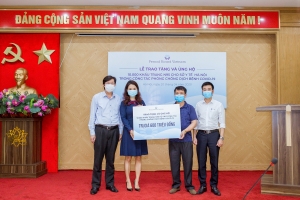
Pernod Ricard contributes to fight against COVID-19 pandemic Pernod Ricard contributes to fight against COVID-19 pandemic

Pernod Ricard has handed over thousands of N-95 masks and protective suits worth more than $55,000 to local health facilities, contributing to Vietnam’s campaign against the COVID-19 pandemic.