UOB: An outstanding year but momentum to slow ahead
Source: UOB

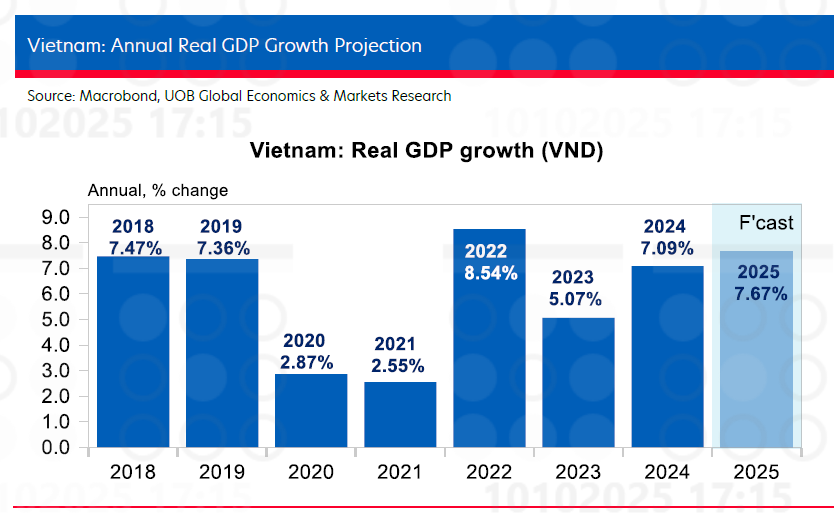
In a report released on December 22, UOB projected fourth-quarter growth at 7.2 per cent on-year, following a strong 8.23 per cent rise in the third quarter – the highest since the post-Covid rebound – after 8.19 per cent in the second quarter. The bank noted that resilient exports and production helped sustain growth despite headwinds from US tariffs.

In the first 10 months of the year, Vietnam’s exports surged 16.8 per cent on-year, despite a high base a year ago at 14.2 per cent on-year. One key driver was shipments to the US, which jumped by 28.1 per cent on-year during the same period (24.3 per cent last year), as orders accelerated (like front-loading) after US reciprocal tariff rates were dialled back to a base rate of 10 per cent globally. Cumulative trade surplus in October came in at $18.7 billion, smaller compared to the $22.4 billion in 2024, due to sharply higher input requirements in response to export demand.

Manufacturing saw a broad-based increase in tandem, increasing 10.8 per cent on-year in the first nine months, a faster pace compared to the 9.4 per cent rise in the same period in 2024. With four consecutive months of above-50 readings, Vietnam’s Purchasing Managers’ Index suggests that the outlook for the manufacturing sector remains positive.

UOB report noted that despite volatility in US trade and tariff policies since early 2025, foreign investment into Vietnam has continued to gain traction, supported by investor confidence in the outlook for the country and ASEAN. As supply chain realignments persist, realised foreign investment recorded $21.3 billion in the first 10 months, well above our expectations of $20 billion for the full year and $19.6 billion in the same period in 2024. The pipeline remains strong, as indicated by registered overseas funding which jumped 15 per cent on-year to $31.5 billion, from $27.3 billion in the same period last year.

Domestic sentiment is similarly upbeat, with retail sales expanding at an average 9.8 per cent on-year in the first 10 months, ahead of the 8.6 per cent pace in 2024. This comes on the back of rising inbound visitors. In the first 10 months, visitor arrivals surged by more than 21 per cent on-year to 17.2 million, from more than 14.1 million in the same period last year. Based on the current momentum, 2025 is on track to exceed the record 18 million visitors in 2019 and will be an added catalyst for domestic spending.

“With real GDP expanding by a robust 7.85 per cent on-year in the first three quarters, Vietnam’s outlook remains positive for 2026,” UOB reported. “However, one downside risk to watch is the implementation of the final reciprocal tariff rates since August, which saw the rate for Vietnam staying at 20 per cent, which could potentially dampen global trade activity going into 2026 as US consumers and producers are burdened with higher import costs.”

Due to a high base in the fourth quarter last year, UOB anticipates the final quarter would be a challenge, given a backdrop of tariffs and trade frictions. As such, UOB anticipates Vietnam’s fourth-quarter growth to slow to 7.2 per cent on-year, for a full-year expansion of 7.7 per cent. It would be even more daunting to achieve the official 8.3-8.5 per cent projection, which would require the fourth quarter expansion in the range of 9.7-10.5 per cent on-year.

“For 2026, Vietnam’s growth pace could moderate slightly to 7 per cent due to base effects and dissipation of front-loading,” UOB anticipated.

Vietnam’s inflation rate has yet to show a meaningful slowdown. Inflation rate in the first 10 months hit 3.3 per cent, compared to the average of 3.6 per cent in 2024 and 3.26 per cent in 2023. Main drivers continue to be costs of housing and construction materials (6.2 per cent on-year average, 18.8 per cent weight) and healthcare (17 per cent on-year average, 5.4 per cent weight).

“Combined with the potential for decent growth prospects going into 2026 and persistent VND weakness, these factors would constrain the State Bank of Vietnam’s (SBV) ability to ease policy,” UOB reported. “As such, we expect the SBV to keep its refinancing rate steady at 4.5 per cent.”

The VND is on track to finish weaker against the USD for the fourth consecutive year. While tariff-related uncertainties weighed on sentiment, stronger-than-expected GDP growth helped limit losses, keeping the year-to-date depreciation at a modest 3.5 per cent, broadly in line with prior years. Volatility remained contained, supported by the SBV holding its benchmark rate steady at 4.5 per cent throughout the year and deploying foreign currency interventions to smooth market fluctuations.

Looking ahead to 2026, UOB expects the VND to continue underperforming regional peers despite a broadly softer USD backdrop. UOB maintains a cautious stance on the VND, and updated USD/VND forecasts are at 26,300 in the first quarter next year, 26,100 in the second quarter, 26,000 in the third quarter, and 25,900 in the fourth quarter.

UOB Vietnam elevates retail banking experience with enhanced credit card suite UOB Vietnam elevates retail banking experience with enhanced credit card suite

UOB Vietnam has unveiled a refreshed credit card portfolio, offering enhanced lifestyle benefits and exclusive privileges through partnerships with renowned brands.

Vietnam's Q3 growth surged on export strength: UOB Vietnam’s Q3 growth surged on export strength: UOB

Vietnam’s economic performance so far in 2025 has been deemed stronger than expected, and with an expansion of 7.85 per cent on-year achieved in the first three quarters, the outlook remains positive for 2025, according to UOB (United Overseas Bank).

Vietnam leads ASEAN in consumer optimism Vietnam leads ASEAN in consumer optimism

Vietnam continues to lead the region in consumer optimism, according to the sixth edition of the ASEAN Consumer Sentiment Study (ACSS) released by UOB on November 20.

On 10 November 2025, the Government issued Decree No. 293/2025/ND-CP prescribing the minimum wage applicable to employees working under labor contracts, effective from 1 January 2026.Compared with Decree No. 74/2024/ND-CP, the monthly regional minimum wage increases by an average of 7.2%, equivalent to an increase of VND 250,000 – 350,000. The hourly minimum wage increases by an average of 6%, equivalent to an increase of VND 700 – 1,700.

Specifically: Region I: The monthly minimum wage increases from VND 4,960,000 to VND 5,310,000 (hourly minimum wage increases from VND 23,800/hour to VND 25,500/hour); Region II: The monthly minimum wage increases from VND 4,410,000 to VND 4,730,000 (hourly minimum wage increases from VND 21,200/hour to VND 22,700/hour); Region III: The monthly minimum wage increases from VND 3,860,000 to VND 4,140,000 (hourly minimum wage increases from VND 18,600/hour to VND 20,000/hour); Region IV: The monthly minimum wage increases from VND 3,450,000 to VND 3,700,000 (hourly minimum wage increases from VND 16,600/hour to VND 17,800/hour).

In addition, Decree No. 293/2025/ND-CP provides guidance on the application of regional boundaries, consistent with changes to administrative boundaries taking effect from July 2025. Specifically, if an employer operates in an industrial park, export-processing zone, high-tech park, or digital-technology zone spanning multiple regions with different minimum wage levels, the employer must apply the highest applicable regional minimum wage. In cases where an employer operates in a newly established administrative area formed from one or more areas with different minimum wage levels, the highest minimum wage shall apply.

To ensure compliance with the new minimum wage requirements, employers should proactively review and adjust relevant provisions in labor contracts, collective bargaining agreements, and internal regulations to align regional minimum wage levels accordingly and safeguard employees’ rights.

On 6 November 2025, the Government issued Decree No. 292/2025/ND-CP detailing and guiding the implementation of Resolution No. 216/2025/QH15 dated 26 June 2025 of the National Assembly on the extension of the agricultural land use tax exemption period (“Decree 292”). This Decree takes effect from 1 January 2026.

Under Decree 292, the agricultural land use tax exemption period is extended for an additional 05 years. Land category classifications for tax calculation purposes continue to be determined in accordance with Decision No. 326/TTg of 1996 and any subsequent decisions of the Prime Minister approving adjustments to the agricultural land tax category classifications (if any).

The entities eligible for agricultural land use tax exemption remain unchanged, including land areas used for research; land used for annual crops; land used for salt production; and agricultural land directly used for production by poor households, households, individuals, and cooperatives. In particular, the determination of “poor households” for purposes of tax exemption for agricultural land allocated or recognized by the State is based on the poverty standards promulgated under Government decrees; however, if the provincial People’s Committee issues its own local poverty standards, the determination must follow the standards issued by that respective provincial-level People’s Committee.

In addition, for agricultural land allocated by the State to organizations or units for management but not directly used for production and instead leased out or contracted to other organizations or individuals, the State shall reclaim the land in accordance with the Land Law. Pending withdrawal, the organizations concerned must pay 100% of the agricultural land use tax.

The agricultural land use tax exemption period under this Decree applies for five years, from 1 January 2026 until the end of 31 December 2030.

Under the rapid growth and strong development of e-commerce, the current legal framework under existing guiding instruments—specifically Decree No. 52/2013/ND-CP and its amending and supplementing documents—has revealed various shortcomings and obstacles, failing to address newly arising issues in the practical operation of e-commerce in Vietnam as well as in cross-border transactions.

With the aim of fully and comprehensively institutionalizing the Party’s orientations and the State’s policies, as well as incorporating international commitments in line with global practices and addressing the inadequacies of the current legal framework, the Ministry of Industry and Trade has completed the draft Law on E-Commerce (the “Draft”). Several notable proposals under the Draft are as follows:

The Draft proposes supplementing specific regulations governing new e-commerce models, including direct e-commerce business platforms, intermediary e-commerce platforms, social networks operating for e-commerce purposes, and multi-service integrated platforms, instead of regulating only websites for e-commerce and e-commerce service websites as currently provided.

The Draft also proposes to expand the responsibilities of individuals involved in selling activities on e-commerce platforms, including the obligations of livestream sellers and affiliate marketers regarding identification of sellers, full disclosure of product information, and avoidance of misleading representations concerning the seller or the nature of the product. The Draft further proposes that domestic sellers be verified through VNeID and foreign sellers through lawful identification documents issued by the country of their residence.

For e-commerce platforms operated by foreign organizations or individuals, the Draft introduces additional requirements for these entities to conduct business in Vietnam. Depending on the type of e-commerce platform, the Draft provides for varying obligations, ranging from appointing or authorizing a legally competent representative in Vietnam to fulfill tax obligations, address disputes, and protect consumer rights, to establishing a legal entity in Vietnam and complying with foreign investment regulations in the e-commerce sector.

In addition, the Draft proposes supplementing minimum responsibilities for service providers supporting e-commerce activities, such as providing authorities with information related to sellers and products upon request; proactively reporting signs of legal violations in e-commerce activities to competent authorities; and terminating cooperation with e-commerce platforms that violate the law when so requested by the authorities.

Overall, the Draft represents an important step toward improving the legal framework governing the e-commerce sector in Vietnam. The proposed amendments and supplements help address the shortcomings of existing regulations, strengthen consumer protection, and create a more transparent environment for business development. The Draft is expected to contribute positively to socio-economic development in the context of Vietnam’s ongoing digital transformation.

After nearly 10 years of implementation, the 2014 Bankruptcy Law has revealed various limitations and practical obstacles. In line with Resolution No. 68-NQ/TW of the Politburo, the Draft Bankruptcy Law (amended) 2025 (“the Draft”) has been developed with significant procedural reforms, prioritizing corporate rehabilitation instead of solely declaring bankruptcy, and is expected to take effect on 1 March 2026. The Draft also introduces simplified procedures and the use of electronic platforms for filings, notifications, and creditor meetings to shorten processing time and enhance transparency.

First, the Draft proposes adjusting the criteria for determining insolvency by extending the overdue period for payable debts from 03 months to 06 months, aiming to prevent premature commencement of bankruptcy proceedings and allow at-risk enterprises additional time to remedy their financial situation.

Next, the Draft proposes introducing a rehabilitation procedure as an independent mechanism that enterprises at risk of insolvency may proactively initiate. Accordingly, an enterprise at risk of insolvency may submit a petition to a competent court requesting rehabilitation, together with a corporate rehabilitation plan. The court may seek opinions on the proposed plan from administrators, asset management enterprises, and relevant organizations and individuals.

Based on these assessments, the competent court may issue a decision approving the rehabilitation plan. During the implementation period of the plan, the enterprise’s business activities will be placed under the supervision of asset management enterprises, and supervisory individuals or organizations, all of whom must submit monthly reports to the court on the plan’s implementation. During this period, creditors are not permitted to request the commencement of bankruptcy proceedings. The enterprise may also suspend interest payments on debts incurred prior to the approval of the rehabilitation plan, have its outstanding tax liabilities frozen, and temporarily suspend contributions to the retirement and survivorship fund.

The court will issue a decision to terminate the rehabilitation plan if the enterprise successfully completes it and restores solvency, or if implementation proves ineffective based on reports from asset management enterprises. Termination also applies where the enterprise engages in prohibited acts—such as gifting or dispersing assets, waiving receivables, prematurely paying debts, or distributing profits—during the rehabilitation period.

Overall, the Draft Bankruptcy Law (amended) 2025 reflects a clear reform-oriented approach, shifting the focus from bankruptcy liquidation toward enhancing corporate rehabilitation mechanisms, while modernizing procedures through simplified steps and digital applications. These revisions are expected to address long-standing shortcomings of the 2014 Bankruptcy Law and establish a more effective and transparent legal framework for corporate restructuring in the coming years.

On 30 November 2025, Decree No. 274/2025/NĐ-CP, detailing the implementation of several provisions of the Law on Social Insurance regarding delayed and evasive contributions to compulsory social insurance and unemployment insurance, as well as complaints and denunciations in the field of social insurance (“Decree 274”), will officially take effect.

Under Decree 274, enterprises that delay or evade the payment of compulsory social insurance and unemployment insurance contributions shall be required to pay an additional interest of 0.03% per day, calculated based on the amount and number of days of delayed or unpaid contributions. This is a strong measure aimed at enhancing deterrence, safeguarding employees’ entitlements, and ensuring strict compliance with insurance obligations.

Notably, Decree 274 also provides that acts of delayed payment may be reclassified as acts of evasion if the enterprise fails to remedy the delay within 60 days from the statutory payment deadline or fails to fulfil its obligations after receiving a written reminder from the social insurance authority.

However, in the spirit of supporting and accompanying enterprises, Decree 274 also recognizes certain circumstances that shall not be considered as acts of evasion, including: severe natural disasters such as storms, floods, or droughts; dangerous epidemics officially declared by competent authorities; impacts caused by a state of emergency as prescribed by law; and other force majeure events as defined under the Civil Code.

With the promulgation of Decree 274, the Government reaffirms its determination to tighten discipline in the implementation of social insurance obligations, while simultaneously promoting transparency and accountability among enterprises in ensuring the lawful rights and benefits of employees.

On October 10, 2025, the Da Nang City Tax Department issued Official Letter No. 1820/DAN-QLDN2 (“Official Letter”) to address enterprises’ inquiries regarding the timing of invoice issuance and the delivery of goods and services at the end of the month in accordance with regulations on invoices and supporting documents.

The Official Letter reaffirms the general principle that the time of invoice issuance is the time when ownership or the right to use goods is transferred to the buyer, or when the provision of services is completed.

Only in cases involving the sale of goods or the provision of services in large quantities and on a frequent basis—such as electricity, water supply, television, telecommunications, securities, computerized lottery, and transportation support services for railway, road, and aviation—may the seller issue monthly invoices based on an agreed-upon billing cycle between the parties.

Accordingly, the Official Letter emphasizes that for transactions not falling under the aforementioned categories, enterprises are not permitted to issue invoices on a monthly basis, even if the parties have a written agreement stipulating the issuance of monthly invoices.

After more than 05 years of implementation, alongside its positive outcomes, the Law on Investment 2020 has revealed several limitations concerning the provisions on investors’ freedom of business, investment incentive and support policies, as well as procedures for carrying out investment and business activities in Vietnam.

With a view to addressing these shortcomings, the Ministry of Planning and Investment has completed the first draft of the Law on Business Investment (“Draft”). The Draft introduces major reform proposals, succeeding and replacing the Law on Investment 2020, with the objective of removing barriers to investment activities, promoting private sector investment, and enhancing national competitiveness. The key highlights of the Draft are as follows:

A significant proposed change under the Draft is the addition of cases exempted from investment policy approval. Specifically, the Draft provides that the following projects shall not be subject to investment policy approval procedures: projects already specified in sectoral or provincial master plans with defined names, scales, objectives, locations, and timelines; projects awarded through land use right auctions or bidding for land-use projects; and mineral exploitation or industrial cluster infrastructure development projects. This change aims to simplify procedures and resolve existing bottlenecks in the current implementation process.

Regarding foreign investment activities, under the current Law on Investment 2020, a foreign investor must have an approved investment project before establishing an economic organization in Vietnam. However, the Draft proposes to abolish this principle, allowing foreign investors to apply for an Enterprise Registration Certificate (ERC) before applying for an Investment Registration Certificate (IRC). This approach increases flexibility for investors but also necessitates stronger control over market access conditions at the enterprise establishment stage, as well as clear guidance on the timeline that the investor must obtain IRC after the issuance of ERC.

Another groundbreaking reform proposed in the Draft is the removal of 17 conditional business lines, including accounting services, rice export, labor subleasing, funeral services, overseas study consultancy, and performing arts, repairing, maintaining of cars, among others.

The Draft also proposes to abolish the list of conditional outward investment sectors and clarify the authority for issuing outward investment registration certificates. Specifically, outward investment projects with capital of VND 20 billion or more shall fall under the licensing authority of the Ministry of Planning and Investment. Projects with capital below VND 20 billion shall not be subject to the outward investment registration certificate requirement; instead, investors will only need to register foreign exchange transactions in accordance with the laws on foreign exchange management.

In addition, a notable revision concerns the adjustment of the scope and criteria for determining investment incentive locations. The Draft categorizes incentive areas into two groups: areas with difficult or particularly difficult socio-economic conditions; and  industrial zones, export processing zones, high-tech zones, concentrated digital technology zones, and economic zones. Accordingly, industrial zones, export processing zones, high-tech zones, concentrated digital technology zones, and economic zones are now established as an independent group of incentive areas, rather than being classified within areas of difficult or particularly difficult socio-economic conditions as before. This approach enables a more tailored design of incentive policies aligned with the characteristics of each type of investment area.

Overall, the Draft represents an important institutional breakthrough, aiming to establish a more open, transparent, and competitive investment environment for both domestic and foreign investors. The proposed reforms — including the abolition and simplification of investment policy approval procedures, enhanced autonomy for foreign investors in enterprise establishment, and the substantial reduction of conditional business sectors — reaffirm the Government’s commitment to fostering private investment and improving Vietnam’s overall investment climate.

On October 9, 2025, the Ministry of Public Security has published the draft Resolution of the Government regarding the removal of notarization and marital status certification procedures (“Draft”). Aiming to meet the objectives of administrative procedure reform and national digital transformation, the Draft Resolution proposes to abolish the requirements for notarization and marital status certification in land and vehicle transactions for cases where data has already been digitized and verified.

The Draft seeks to simplify administrative procedures by completely eliminating paper-based documents for two types of transactions: transactions involving the sale, transfer, donation, mortgage, or inheritance of land use rights and assets attached to land; and) transactions involving the sale, transfer, donation, or registration of ownership of vehicles.

Accordingly, instead of requiring notarization and paper-based certification, these procedures would be integrated and automated based on existing data available in the national databases on population, civil status, land, and vehicles.

The Draft also emphasizes and affirms the legal validity of digitized and electronically authenticated data. Data collected and verified from these national databases will have the same legal effect as paper documents, and citizens will not be required to resubmit documents that already exist in the national data systems. Officials and civil servants will be responsible for retrieving and verifying information directly from the electronic system, rather than requesting paper copies from citizens.

With respect to implementation procedures, the Draft Resolution proposes to abolish the requirement for notarization and marital status certification in relevant administrative processes to eliminate unnecessary formalities, thereby reducing costs, shortening processing time, and minimizing overlapping documentation.

For cases where data has been digitized and authenticated, citizens will only need to log into the National Public Service Portal or the VNeID application to declare transaction information. The electronic data system will automatically verify personal information, marital status, land use rights, and vehicle ownership. Contracts will be created, signed, and stored on the electronic platform, with transaction results returned either online or in person, depending on the citizen’s choice.

In cases where such data has not yet been digitized within the national databases, the competent authority may request paper documents once only, while also guiding citizens on updating their information to enable simplified procedures for future transactions.

Overall, the Draft Resolution is considered a breakthrough in institutional reform, establishing a legal framework for the use of electronic data in civil transactions. It is expected to significantly reduce administrative procedures, costs, and processing time for both citizens and businesses, while enhancing public satisfaction and trust in the Government amid the ongoing process of digital transformation and international integration.

1. Draft Law on Investment: Breakthrough to promote private investment and enhance national competitiveness
After more than 05 years of implementation, alongside its positive outcomes, the Law on Investment 2020 has revealed several limitations concerning the provisions on investors’ freedom of business, investment incentive and support policies, as well as procedures for carrying out investment and business activities in Vietnam.
With a view to addressing these shortcomings, the Ministry of Planning and Investment has completed the first draft of the Law on Business Investment (“Draft”). The Draft introduces major reform proposals, succeeding and replacing the Law on Investment 2020, with the objective of removing barriers to investment activities, promoting private sector investment, and enhancing national competitiveness. The key highlights of the Draft are as follows:

A significant proposed change under the Draft is the addition of cases exempted from investment policy approval. Specifically, the Draft provides that the following projects shall not be subject to investment policy approval procedures: projects already specified in sectoral or provincial master plans with defined names, scales, objectives, locations, and timelines; projects awarded through land use right auctions or bidding for land-use projects; and mineral exploitation or industrial cluster infrastructure development projects. This change aims to simplify procedures and resolve existing bottlenecks in the current implementation process.
Regarding foreign investment activities, under the current Law on Investment 2020, a foreign investor must have an approved investment project before establishing an economic organization in Vietnam. However, the Draft proposes to abolish this principle, allowing foreign investors to apply for an Enterprise Registration Certificate (ERC) before applying for an Investment Registration Certificate (IRC). This approach increases flexibility for investors but also necessitates stronger control over market access conditions at the enterprise establishment stage, as well as clear guidance on the timeline that the investor must obtain IRC after the issuance of ERC.

Another groundbreaking reform proposed in the Draft is the removal of 17 conditional business lines, including accounting services, rice export, labor subleasing, funeral services, overseas study consultancy, and performing arts, repairing, maintaining of cars, among others.

The Draft also proposes to abolish the list of conditional outward investment sectors and clarify the authority for issuing outward investment registration certificates. Specifically, outward investment projects with capital of VND 20 billion or more shall fall under the licensing authority of the Ministry of Planning and Investment. Projects with capital below VND 20 billion shall not be subject to the outward investment registration certificate requirement; instead, investors will only need to register foreign exchange transactions in accordance with the laws on foreign exchange management.

In addition, a notable revision concerns the adjustment of the scope and criteria for determining investment incentive locations. The Draft categorizes incentive areas into two groups: areas with difficult or particularly difficult socio-economic conditions; and industrial zones, export processing zones, high-tech zones, concentrated digital technology zones, and economic zones. Accordingly, industrial zones, export processing zones, high-tech zones, concentrated digital technology zones, and economic zones are now established as an independent group of incentive areas, rather than being classified within areas of difficult or particularly difficult socio-economic conditions as before. This approach enables a more tailored design of incentive policies aligned with the characteristics of each type of investment area.

Overall, the Draft represents an important institutional breakthrough, aiming to establish a more open, transparent, and competitive investment environment for both domestic and foreign investors. The proposed reforms — including the abolition and simplification of investment policy approval procedures, enhanced autonomy for foreign investors in enterprise establishment, and the substantial reduction of conditional business sectors — reaffirm the Government’s commitment to fostering private investment and improving Vietnam’s overall investment climate.

2. Breakthrough proposal in eliminating notarization and marital status certification in land and vehicle transactions

On October 9, 2025, the Ministry of Public Security has published the draft Resolution of the Government regarding the removal of notarization and marital status certification procedures (“Draft”). Aiming to meet the objectives of administrative procedure reform and national digital transformation, the Draft Resolution proposes to abolish the requirements for notarization and marital status certification in land and vehicle transactions for cases where data has already been digitized and verified.

The Draft seeks to simplify administrative procedures by completely eliminating paper-based documents for two types of transactions: transactions involving the sale, transfer, donation, mortgage, or inheritance of land use rights and assets attached to land; and) transactions involving the sale, transfer, donation, or registration of ownership of vehicles.

Accordingly, instead of requiring notarization and paper-based certification, these procedures would be integrated and automated based on existing data available in the national databases on population, civil status, land, and vehicles.

The Draft also emphasizes and affirms the legal validity of digitized and electronically authenticated data. Data collected and verified from these national databases will have the same legal effect as paper documents, and citizens will not be required to resubmit documents that already exist in the national data systems. Officials and civil servants will be responsible for retrieving and verifying information directly from the electronic system, rather than requesting paper copies from citizens.

With respect to implementation procedures, the Draft Resolution proposes to abolish the requirement for notarization and marital status certification in relevant administrative processes to eliminate unnecessary formalities, thereby reducing costs, shortening processing time, and minimizing overlapping documentation.
For cases where data has been digitized and authenticated, citizens will only need to log into the National Public Service Portal or the VNeID application to declare transaction information. The electronic data system will automatically verify personal information, marital status, land use rights, and vehicle ownership. Contracts will be created, signed, and stored on the electronic platform, with transaction results returned either online or in person, depending on the citizen’s choice.

In cases where such data has not yet been digitized within the national databases, the competent authority may request paper documents once only, while also guiding citizens on updating their information to enable simplified procedures for future transactions.

Overall, the Draft Resolution is considered a breakthrough in institutional reform, establishing a legal framework for the use of electronic data in civil transactions. It is expected to significantly reduce administrative procedures, costs, and processing time for both citizens and businesses, while enhancing public satisfaction and trust in the Government amid the ongoing process of digital transformation and international integration.

3. Tightening measures against delayed or evasive social insurance contributions
On 30 November 2025, Decree No. 274/2025/NĐ-CP, detailing the implementation of several provisions of the Law on Social Insurance regarding delayed and evasive contributions to compulsory social insurance and unemployment insurance, as well as complaints and denunciations in the field of social insurance (“Decree 274”), will officially take effect.

Under Decree 274, enterprises that delay or evade the payment of compulsory social insurance and unemployment insurance contributions shall be required to pay an additional interest of 0.03% per day, calculated based on the amount and number of days of delayed or unpaid contributions. This is a strong measure aimed at enhancing deterrence, safeguarding employees’ entitlements, and ensuring strict compliance with insurance obligations.

Notably, Decree 274 also provides that acts of delayed payment may be reclassified as acts of evasion if the enterprise fails to remedy the delay within 60 days from the statutory payment deadline or fails to fulfil its obligations after receiving a written reminder from the social insurance authority.

However, in the spirit of supporting and accompanying enterprises, Decree 274 also recognizes certain circumstances that shall not be considered as acts of evasion, including: severe natural disasters such as storms, floods, or droughts; dangerous epidemics officially declared by competent authorities; impacts caused by a state of emergency as prescribed by law; and other force majeure events as defined under the Civil Code.

With the promulgation of Decree 274, the Government reaffirms its determination to tighten discipline in the implementation of social insurance obligations, while simultaneously promoting transparency and accountability among enterprises in ensuring the lawful rights and benefits of employees.

4. Guidance on monthly invoice issuance

On October 10, 2025, the Da Nang City Tax Department issued Official Letter No. 1820/DAN-QLDN2 (“Official Letter”) to address enterprises’ inquiries regarding the timing of invoice issuance and the delivery of goods and services at the end of the month in accordance with regulations on invoices and supporting documents.

The Official Letter reaffirms the general principle that the time of invoice issuance is the time when ownership or the right to use goods is transferred to the buyer, or when the provision of services is completed.

Only in cases involving the sale of goods or the provision of services in large quantities and on a frequent basis—such as electricity, water supply, television, telecommunications, securities, computerized lottery, and transportation support services for railway, road, and aviation—may the seller issue monthly invoices based on an agreed-upon billing cycle between the parties.

Accordingly, the Official Letter emphasizes that for transactions not falling under the aforementioned categories, enterprises are not permitted to issue invoices on a monthly basis, even if the parties have a written agreement stipulating the issuance of monthly invoices.

5. Ho Chi Minh City implements electronic business registration certificates

On October 24, 2025, the Ho Chi Minh City Department of Finance issued Notice No. 10441/TB-STC on the implementation of digital signing for the results of administrative procedures in the field of enterprise registration.

According to the notice, from October 25, 2025, the results of administrative procedures such as applications for new business registration certificates or amended business registration certificates will be issued in electronic form instead of paper form as previously. The business registration authority will no longer issue paper versions, and the electronic certificates will hold the same legal validity as paper documents.

The implementation of electronic business registration certificates in Ho Chi Minh City marks the next step in the city’s digital transformation of business registration procedures, helping to simplify processes, reduce costs, and save time for enterprises.

Previously, the Hanoi Business Registration Office had already adopted the issuance of electronic certificates, and this policy is expected to be rolled out nationwide in the near future in line with the overall trend toward digitalization.

The introduction of electronic business registration certificates demonstrates the government’s strong commitment to administrative reform and digital transformation, while also facilitating a more convenient and efficient process for enterprises in fulfilling their business registration requirements.